

‘Main Vaapas Aaunga’ is everywhere right now. The internet has already crowned it Imtiaz Ali’s best work.
I walked into the theatre wanting to agree with that verdict because I’m a die-hard Imtiaz Ali fan. I love how he treats emotion, how he lets it sit instead of rushing past it.
I left having cried more than once during the screening of ‘Main Vaapas Aaunga.’ And yet I think this might be his weakest film, not his strongest.

The trouble starts with the story itself, or rather, with how many stories it’s trying to tell at once.
On the surface, this is a love story set during partition, which then widens into a story about partition itself, the families it broke and the trauma it left behind.
Give it a few scenes more and it widens again, this time into something closer to a statement about what war does to everyone it touches, the living and the dead.
Three distinct films are competing for the same runtime, and none of them get the space to become whole.
A story that tried to do one of these things well would have hit harder than a story that tries to do all three.
That dilution shows up most clearly in the characters.
Somewhere in the second half, I realised I had lost track of who the female lead actually was. She’s introduced as Jiya. Later she’s called Afsana. At some point a name appears tattooed on an arm that said Mallika Dil Fareb, and I still can’t say for certain which it was. If a film can’t keep me anchored to a character’s name, it has already lost me on her story.
The central love story carries the same disorientation. In their intro scene together, the two leads seem to be meeting for the first time. In the next, they interact like people who have known each other for years. I was never sure what point in their relationship I was watching, which meant I was never sure what I was meant to be rooting for.
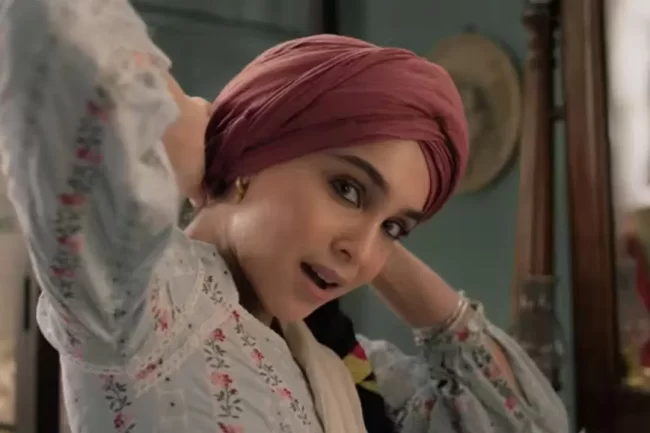
There is one idea buried in this film that could have carried the entire narrative on its own. The women of this family are spoken of as cursed, dying young, one after another, and it’s the reason the opening credits are sung by women rather than played over a title card. That is a devastating premise. It deserved to be the film’s spine. Instead, it surfaces for a few seconds and disappears, treated as texture rather than as the story it clearly wanted to be.
Keenu’s arc suffers from the same instinct to gesture at emotion rather than build it. As a young man, he’s soft, romantic, almost boyish in how he loves. As an old man, his own son resents him for being distant and absent. The film tells us this shift happened. It never shows us why, or what broke in him along the way. I never knew which version of Keenu I was supposed to carry with me, the young man or the old one, and a nonlinear structure that keeps cutting between timelines only widens that gap, not just for the leads but for every character orbiting them.
And yet, the ending lands almost entirely because of Naseeruddin Shah.
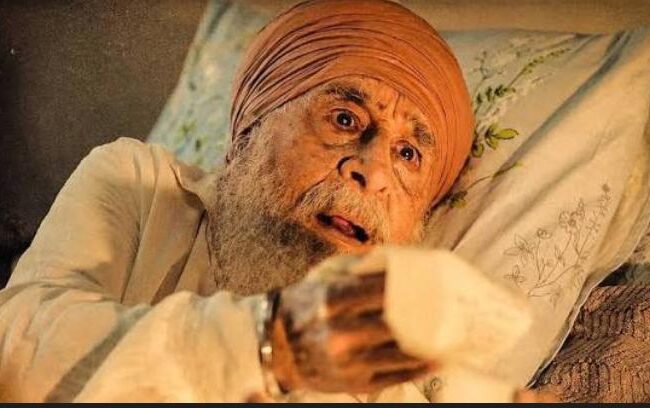
His mannerisms carry decades of grief, an unfulfilled love, and a mind slowly losing its grip, all at the same time, without a single line needing to explain any of it. He is the reason I cried in that theatre. Take his performance out of this film and I don’t think it has a heartbeat left.
What stays with me isn’t that ‘Main Vaapas Aaunga’ is a bad film. It’s that it had the material for a genuinely great one, three times over, and chose to attempt all three rather than commit to one.
A love story during partition.
A story about the families partition tore apart.
A story about what war leaves behind long after the fighting ends.
Any one of these, told fully, would have been the film everyone is currently calling this one. Instead, it holds all three at once, and asks none of them to be whole.