LSD 2(Love, Sex Aur Dhoka 2), directed by Dibakar Banerjee, is a spiritual sequel to the 2010 film of the same name. The common factor between these films is that the narrative is divided into three segments, telling us interlinked stories of different people.
In LSD (2010) the ‘Love,’ ‘Sex’ and ‘Dhoka’ segments were titled Superhit Pyaar, Paap Ki Dukkaan and Badnaam Shohorat. The prequel was made using spy cameras, handy cams, security cameras, and an underwater camera, which gave a final output. These interlinked stories dealt with honour killings, an MMS scandal and a sting operation with a non-linear narrative. LSD 2has a similar non-linear structure with a modern touch.
The non-linear narrative (written by the director along with the writers of Eeb Allay Ooo! (Prateek Vats and Shubham ) in Banerjee’s LSDsequel delves into friendship, love, self-discovery and complexities in modern relationships in the digital era. The film is more Gen-Z oriented, which also shows us the dark side of social media and living a dual life in an increasingly virtual reality.
The segments in Love, Sex Aur Dhoka 2are titled “Like,” “Share,” and “Download.” The stories are interlinked and the key incidents of another story affecting the protagonist in each segment can be noticed.
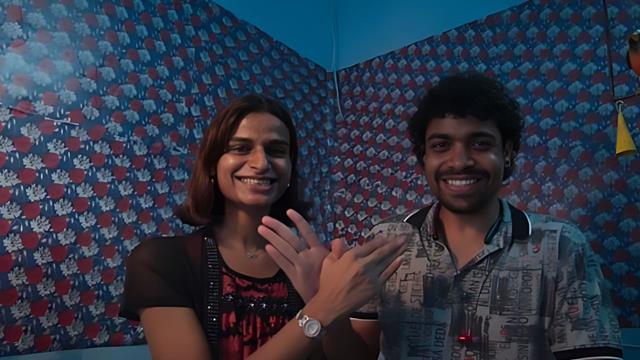
The first one (Like) revolves around Noor (played by Paritosh Tiwari), a trans contestant on a reality show called ‘Truth ya nach’ (which resembles the sets of Big Boss and Nach Baliye). The judges are Anu Malik playing Prem Desi, Tusshar Kapoor as Tusshar, Sophie Choudhary as Sophie (all in cameos) and Mouni Roy as anchor and show coordinator Soni. The narrative is about Noor doing her best to win the show by increasing the likes, which depends on how much reality is unravelled and how long she is on camera.
In the next segment (Share), damage control manager Lovina Singh (Swastika Mukherjee) has to save her company’s reputation as a sexually equivocal Metro Railway Station employee, Kulu (Bonita Rajpurohit) is terribly assaulted. All the social work and the care-for-the-employee ends when a reality check is thrown at us as Lovina says “Get that thing out of my station tonight.” There is a death of a child in the same school where Lovina’s son goes to.
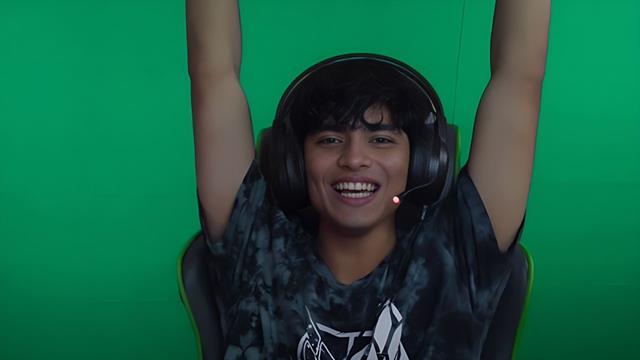
The incident is carried to the last segment (Download). Here, an 18-year-old Shuham Narang’s (Abhinav Singh) aka ‘Gama Pappi’(his virtual name) life revolves in a virtual world where his subscribers help him roll out money. Soon things turn upside down when virtual reality hits him back literally making him strip himself naked in front of the camera. Later, we are taken into a world of virtual reality.
Unlike its predecessor, LSD 2 loses the touch of the level of visual rawness as there are no spy cameras or any security cameras where the visual quality is blurry which seem as if we are watching someone’s stolen sex tape. But, the shooting techniques are similar and no camera angle or movement is left while filming this movie. The handheld camera movements are at their best. And, so are the sharp cuts by the editor (Naman Arora).
LSD 2is bold and sharp with the technicalities. So is terrific music by Sneha Khanwalkar and lyrics by the director himself. This dark film is not for the soft-hearted people and not for the ones who plan to watch this film with their families.
Gothicism is a difficult genre to come by in the mainstream Hindi-film industry, finding a well made movie of that niche is far more rare. In this piece, I will be outlining the seven reasons why Vishal Bhardwaj’s 7 Khoon Maaf (7 Murders Forgiven), inspired by the Ruskin Bond novel, Susanna’s Seven Husbands, hits the genre on the nail.
The Anti-Hero
At the mention of a gothic heroine, the characteristic image of an otherworldly attractive and wealthy woman who has had to endure a number of misfortunes is evoked. Susanna Anna-Marie Johannes (Pryianka Chopra Jonas), the protagonist, certainly ascribes to all three of these conventions.
The femme fatale’s beauty entraps her victim’s who often use her for her riches and the untimely deaths of her parents mark the first two adversities of her life. However, despite the clear affliction of her orphan-hood which left Susanna “udaas” (sad) and “akeli” (lonely), she makes death a reoccurring event in her life. This is foreshadowed within the first ten minutes of the film by the narrator, Arun Kumar (Vivaan Shah). His statement that black, the colour of mourning, grief, funerals and death, “waqt ke saath…unka rang bangaya” (with time, became her colour) elucidates that she will be the culprit of the seven murders mentioned in the title.
This holds to be true and it is the homicides she plans with her band of three, Maggie (Usha Uthup), Goonga (Shashi Malviya) and Ghalib (Harish Khanna), that display her most obvious villain-like characteristics. However, each of her murders are coupled with the reasons of trying to escape various forms of abuse at the hands of her husbands and also to seek retribution against their wrongs. Hence, despite the magnitude of Susanna’s seven evil acts, she cannot be called the villain of the film, making her an anti-heroine.
Religious Concerns
Catholicism plays an active role in gothic stories and this may be due to the generally anti-Catholic political mindset that was occurring particularly in England during the emergence of this genre. 7 Khoon Maaf personifies the seven deadly sins, also called the seven capital/cardinal sins, of Roman Catholic Theology, through each of Susanna’s victims.
Pride — Her first husband and hence her first murder, Major Edwin Rodriguez (Neil Nitin Mukesh), represents Pride; the sin of believing superiority in oneself. The major depicts this most severely when he blinds Goonga during a duel, picking on a weaker component in an attempt to reassert his masculinity and power. The serious injury to her loyal servant was enough reason for the heroine to end Edwin’s life.
Sloth — Susanna’s second husband Jamshed Singh Rathod “Jimmy” (John Abraham), embodies sloth. Sloth refers to the failure to employ one’s talents and after all Jimmy does steal other artists compositions to become a successful singer. This time Susanna had a “rishta bachane ki zid” (stubbornness to save her marriage) so after discovering the fraudulent and cheating actions of her second husband, she persisted, buying the music he stole and trying to get help for his drug addiction. Clearly, she wasn’t stubborn enough because at the discovery that Jimmy did not remain sober, she decided to commit her second murder.
Wrath — Husband number three, the poet Wasiullah Khan (Irrfan Khan) is wrath, which is the feeling of overwhelming hate and anger towards another. His wrath appears in his physical abuse which in its own depraved way was the only thing that got the poet aroused. It is during this marriage that Susanna’s servants (Maggie, Goonga and Ghalib) are first seen as actively participating in the homicide.
Envy — Nikolai Vronsky (Alexander Diachenko) represents envy; the intense desire to possess what another has. Susanna’s dialogue at the beginning of her courtship with the foreigner, “you are jealous of Russians” basically spells this out and foreshadows how the reason for her third murder is rather because of her own feelings, than those of her fourth husband. At the discovery of his life with another wife and children in Russia, she ends her jealousy by ending him.
Lust — Susanna finds it difficult to escape authorities with the murder of her fourth husband so she fulfills the desires of the officer handling the case as a sort of bribe. The fifth husband, Keemat Laal (Annu Kapoor), embodies the sin of lust; a strong longing for sexual gratification. The murderess had only intended her favour to be a once off thing, but Keemat’s sexual desires could never be satisfied. Hence, in order to break free from the man, but still maintain her innocent status, she had to commit yet another homicide.
Greed — Dr. Modhusudhon Tarafdhar (Naseeruddin Shah) the sixth husband is Greed, which is the excessive desire for materialistic goods. Perhaps in an attempt to get an inheritance, the doctor tries to play the heroine’s own game against her, but fails and is brutally killed in a game of Russian Roulette.
Gluttony — Susanna’s seventh murder was not that of another husband, but rather her own metaphorical death. She represents the final sin of gluttony. Often associated with the overconsumption of food and drink, however it can also refer to selfishness and not considering how one’s actions can affect another. When Susanna fakes her death to escape authorities, her old-self, the one that would inflict pain upon others without hesitation, is killed.
Myths and Legends
The Faustian Bargain is a literary concept originating from the German legend of Johann Georg Faust, a highly intelligent and accomplished, yet dissatisfied man who makes a pact with the Devil to sell his soul for unlimited knowledge and power.
The bargain can be witnessed in a number of Gothic stories, The Picture of Dorian Gray by Oscar Wilde being a great example.
In this novel, the main character realises his beauty after seeing a portrait of himself and begs that age and ugliness does not appear on his face, but on the painting, a wish that is fulfilled. Susanna does seem to have a sort of Faustian pact given that despite her horrific crimes she remains not convicted of them. In fact, as the title says ‘Maaf,’ she is forgiven of what she has done.
However, unlike Faust her pact is not with the devil, but with Jesus. Throughout the film the protagonist speaks of Jesus in endearing terms and even attempts to form a closer connection with him, traveling to Kashmir where he supposedly lived his last days. The dialogue “wo mujhe mere gunnahon…ke saath apna raha hai” (he has accepted me with my sins) suggests a close personal relationship between Susanna and the son of God.
Susanna solidifies this relationship with a seventh marriage. Entering the order of nuns, she marries Jesus in a ceremony vowing servitude and even wearing a wedding ring. Their connection is most blatant in the penultimate scene which depicts her and Jesus dancing in the Sufi style of Semazen as they relive her murders with the song lyrics “tum chup rahe te ho” (you remain quiet) playing in the background.
Perhaps it was Jesus choosing to not speak up that kept her free of consequences and the ring in the wedding-like ceremony to become a nun, the symbolic representation of her Faustian Bargain.
Emphasis on Nature
Nature is a reoccurring element of Gothicism often depicting itself within the setting and topography to underscore the emotions of horror and gloom.
In Vishal Bhardwaj’s 7 Khoon Maaf fauna and flora are a powerful device used by the characters to bring about death. This is seen in the first murder where Major Edwin Rodriguez is pushed by Susanna towards a “man eating panther.”
The second time nature serves as a lethal tool, is for husband number four, Nikolai Vronsky, who is coerced to climb into a well, that the audience has already been made aware, is full of Susanna’s poisonous “paltu” (pets) — snakes.
The final time, flora as a opposed to dangerous animals is used to kill, however it is Dr. Modhusudhon Tarafdhar an expert of allopathy and naturopathy that concocts a fatal mushroom soup. Though Susanna escapes this threat to her life, her servant Ghalib falls prey to the seemingly innocent lunch and for the first time an unintended death takes place.
The Gothic Double
The Gothic Double explores the concept of doppelgängers and duality. In ‘The Picture of Dorian Gray’ Dorian and the realistic portrait of himself is an example of the double. In Matt Reeves’ 2022 take on the iconic superhero, Bruce Wayne and Batman serve as a duality in the characters personality. In 7 Khoon Maaf Susanna takes this a step further and instead of having one persona she creates seven.
In her first and sixth marriage she remains Susanna, in her second she becomes Jimmy’s Suzie even changing her attire, wearing leather jackets and skirts to reflect her rock-star husband. For her third she opts for the Urdu name Sultana and seemingly converts to Islam, given her adoption of the hijab, in order to match the Urdu poetry and religious beliefs of her lover. In her fourth marriage to the Russian Nikolai Vronsky, Susanna shortens to Anna, a reflection of the Russian classic ‘Anna karenina.’
Then she transforms to Sunaina in her fifth marriage. The femme fatale’s sixth personage, Saheb, is the one regarded by her servants and her seventh identity is born when she becomes a nun. Just as the vigilante Batman commits crimes he could not morally and literally get away with as Bruce Wayne and just as Dorian Gray’s immoral acts are projected as physical distortions on the painting instead and not him, Susanna creates this array of personalities so that she can flout social responsibilities and blame her transgressions on the double instead.
Explorations of Romance and Sexuality
Gothicism is a category of film and literature not afraid to depict the more shunned and risqué aspects of romance and sexuality. Having the excessive number of six husbands, the Rockstar Jimmy with his multiple affairs, the poet Wasiullah Khan’s demented arousal at the torture of his sexual partners and inspector Keemat Laal’s disregard of justice for the sake of sensual pleasures are all certainly instances of the genre’s flagrant representations of love and sex.
However, it is the reverse of the oedipal complex, a term coined by Sigmund Freud referring to sexual desires a child has towards a parent, that is the most confounding and disturbing relationship in 7 Khoon Maaf. Arun Kumar, the narrator of the film, is a boy hardly fifteen years younger than Susanna who financially adopts him, hence there is a sort of parent child relationship between them.
To Arun the opportunity of an education makes Saheb look like a God to him, however this image progressively deteriorates with her immoral acts and is finally annihilated when the heroine strips naked In front of a now adult Arun and attempt to seduce him, desiring more so company in her “akali” (lonely) life than sexual gratification.
The oedipal complex is clearly a line stepped too far across for Arun and so he doesn’t see the woman again for many years. Which brings me to the final gothic element of 7 Khoon Maaf — Revisiting the Past.
Revisiting the Past
The past plays a key role in Gothic films in the sense that it literally comes back to haunt the characters, either via more rational consequences or mystical ones of ghosts, curses and omens. In Vishal Bhardwaj’s 7 Khoon Maaf it is the former, where the inexplicable debts Arun owes to Susanna for providing him with an education, come back to haunt him where he has to mentally, later physically chooses to, revisit the place of his childhood that was full of Saheb’s dreadful deeds and perhaps for the first time, come to terms with them.
The film begins in the present and in media res, in the middle of the scene, leaving it at a cliff hanger until the narrator Arun recounts all the events leading up to it. Then finally returning to the present towards the last quarter only to conclude with Susanna returning to the past by confessing her sins.
Have you ever wondered why you’re drawn to certain film genres over others? From heart-warming romcoms to spine-tingling thrillers, each movie genre holds a mirror to our quirks and idiosyncrasies, revealing fascinating insights into our personalities and choices. Let’s see what your cinematic preferences reveal about you:
Note: This article is for entertainment purposes only. Consider it a comic relief in your movie marathon!!
Romantic Comedy (Rom-Com):
If your heart races at the thought of love-struck protagonists navigating through hilarious mishaps and heart-warming moments, then you’re probably a hopeless romantic with a knack for finding joy in the little things.
Traits:
You’re in love with a fictional character.
You use rom-com movie quotes in daily conversations.
Thriller:
If you thrive on the edge of your seats, eagerly anticipating plot twists and gripping suspense, you’re likely an adrenaline junkie with a taste for the unexpected. You revel in the thrill of unravelling mysteries and deciphering clues.
Traits:
Have trust issues.
Have a detailed emergency escape plan for every location you visit.
Sci-Fi:
If you’re drawn to intergalactic adventures of futuristic worlds and mind-bending concepts, you’re probably a visionary thinker with a passion for exploring the unknown. You like to challenge conventional thinking and discuss the universe’s infinite possibilities.
Traits:
Constantly daydream about time travel and alternate realities.
Own “essential gadgets” to survive an apocalypse.
Mastered the art of parallel parking in a crowded city.
Horror:
Spine-chilling adrenaline rush with jump scares and hair-raising thrills are your go-to genre. You’re a thrill-seeker with nerves of steel.
Traits:
Practice horror movie screams in the shower.
Convince yourself that you actually love horror.
Action:
For those who crave high-octane excitement and pulse-pounding showdowns, you’re probably a fearless adventurer with a penchant for living life on the edge. You thrive in the fast lane and never back down from a challenge.
Traits:
You remember every action move in any movie, ever.
Sing the signature tune of Dhoom every time you pass a fancy bike… and you’re singing it now!
Fantasy:
If you like “Fantasy”, you live in a fantasy world you’ve created in your mind. You’re a dreamer with an insatiable imagination and can probably narrate every single word from the Harry Potter series.
Traits:
You know the meaning of Alohomora.
Your dog’s name is Khaleesi.
Coming-of-Age:
Do you find yourself nostalgically reminiscing about the awkward yet transformative moments of youth? If so, you’re probably a sentimental soul with a fondness for stories about self-discovery and growth.
Traits:
You take photos of everything, everywhere, all the time.
May or may not be an influencer…
Documentary:
Inspiring stories of leaders, compelling narratives of nature, thought-provoking insights on what the food industry, and uncovering truths about a murder tickle your fancy. Documentaries are your favortie because you appreciate the raw authenticity and depth of storytelling that they offer.
Traits:
You’re a perpetual fact-checker.
Your browser history gets a makeover regularly.
Noir:
Moody atmospheres, morally ambiguous characters, and gritty urban landscapes are your thing. You’re a connoisseur of noir with a taste for dark and mysterious narratives, and you’re drawn to stories that blur the lines between right and wrong.
Traits:
You have a love-hate relationship with your whiskey.
You’ve always wanted to paint your room black.
Mystery:
Are you fascinated by puzzles, cryptic clues, and thrilling whodunits? If so, you’re likely a sleuth at heart with a keen eye for unravelling mysteries and solving intricate plots.
Traits:
Your go-to weekend is a visit to an escape room – alone!
You solve 5000-piece puzzle everyday – alone!
Sports:
Well, you love sports and sports films! You’re likely a spirited competitor with a love for the camaraderie and adrenaline rush of sports. Whether it’s experiencing the triumphs and trials of underdog athletes or rooting for underdog teams, you embody the indomitable spirit of sportsmanship.
Traits:
You’re the reigning champion of ping-pong tournaments.
Complete the speech: Sattar Minute Hai Tumhare Paas.
Drama:
You’re highly emotional and complex individual with a sensitive soul. You’re drawn to poignant storytelling and have a deep appreciation for the human experience that tug at the heartstrings.
Traits:
Can cry on command.
Treat everyday conflict like a dramatic plot twists of a K-drama.
The next time you’re debating movie night options, remember to choose wisely – because your favorite film genre just might be revealing more about you than you ever imagined.
When army commando Amrit (Lakshya) finds out his true love Tulika (Tanya Maniktala) is engaged against her will, he boards a New Delhi-bound train in a daring quest to derail the arranged marriage. But when a gang of knife-wielding thieves led by the ruthless Fani (Raghav Juyal) begin to terrorise innocent passengers on the train, Amrit takes them on himself in a death-defying kill-spree to save those around him — turning what should have been a typical commute into an adrenaline-fuelled thrill ride.
Crew is a bumpy yet fun cinematic ride with lots of laughter and amazing performances. The leading ladies are air hostesses Kriti Sanon (who plays newbie Divya Rana), Tabu as middle-aged and senior most Geeta Sethi and Kareena Kapoor Khan as mid-career Jasmine Kohli. These women make a brilliant trio for a heist and also in the film’s cast. The plot revolves around them getting voluntarily involved in a gold smuggling racket after giving up on living a middle-class life due to each one of them facing a financial issue.
This is the second film of the director Rajesh Krishnan after his debut with Lootcase in 2020. Loocase was a black comedy and also revolved around money, a gangster and a middle-class man. If I am not mistaken, Crew is the first heist-comedy in Bollywood with female characters in the lead.
The narrative has some interesting and memorable comic scenes, but we don’t get them often. In a scene, when the pilot lands the plane on a bumpy runaway and when the plane barrels on it, a character reacts in panic and screams, “Horn Maar!” in the cockpit. There are more of this kind of jokes which land smoothly in every scene. But, I couldn’t resist saying that Crew lacks uniqueness when it comes to writing. A lot of narrative seems to be inspired by Vijay Mallya’s case. In the film, the airline where these air hostesses work is named “Kohinoor.” The delayed payments of the employees, bankruptcy rumours and the chairman of the company, coincidently named “Vijay” Walia eloping to another country.
The writers Nidhi Mehra and Mehul Suri work pretty well on the dialogues. Kareena and Tabu get the best lines to speak. In a scene, Geeta (Tabu) who was once Miss Karnal says, “beauty queen se bai kab bani, pata hi nahi chala.”
I loved the lead and the supporting cast, which included Kapil Sharma, Diljit Dosanjh (in an extended cameo), Rajesh Sharma, and amazing Shaswata Chatterjee and it was a pleasure to see Kulbhushan Kharbanda on the big screen after a long time. The costumes designed for the crew had catchy colours and added glam to the graceful performances that these wonderful actresses gave. The way each of them was styled was a well-done job by Manisha Melwani, Chandini Wabhi, and Meagan Concessio.
The worst part of the film is the brand advertisements in the scenes which restrain us from delving into the narrative and ruin the experience. And, the makers have already destroyed the nostalgia by remixing the “Choli Ke Peeche” and I never get the idea of doing that especially when the song does not fit in the narrative and is misplaced just for the sake of doing so.
Crew could have been better if the makers had built a better narrative for the heist comedy as they had the privilege of getting three dazzling actresses on board, each of them alone can hook us to the screen for a long time. As a commonly found phrase on social media, these actresses ‘ate and left no crumbs.’
It’s not a Sriram Raghavan film, where we find a dead body and all the mysterious fun revolving around it. But here the film’s title itself gives us a glimpse of what the viewer is signing up for. Homi Adajania’s Murder Mubarak is a murder mystery where the murder is less stressful and more of a relief for the characters around the demised person.
The film, written by Gazal Dahiwala and Suprotim Sengupta is based on Anuja Chauhan’s 2021 book ClubYou ToDeath.
The plot is set around the Royal Delhi Club and revolves around its eccentric elite members (the prominent characters who are an eligible candidate for becoming a museum piece).
Leo Mathews (played by Aashim Gulati), is a horny hustler who has access to everyone’s secrets only to blackmail them to donate to an orphanage. His sudden death creates a ruckus among the club members on “Whodunit” especially after the investigation questions if he is murdered.
The club is bagged with unique members whose introduction during the film’s opening credits ruins the suspense of guessing their characteristics.
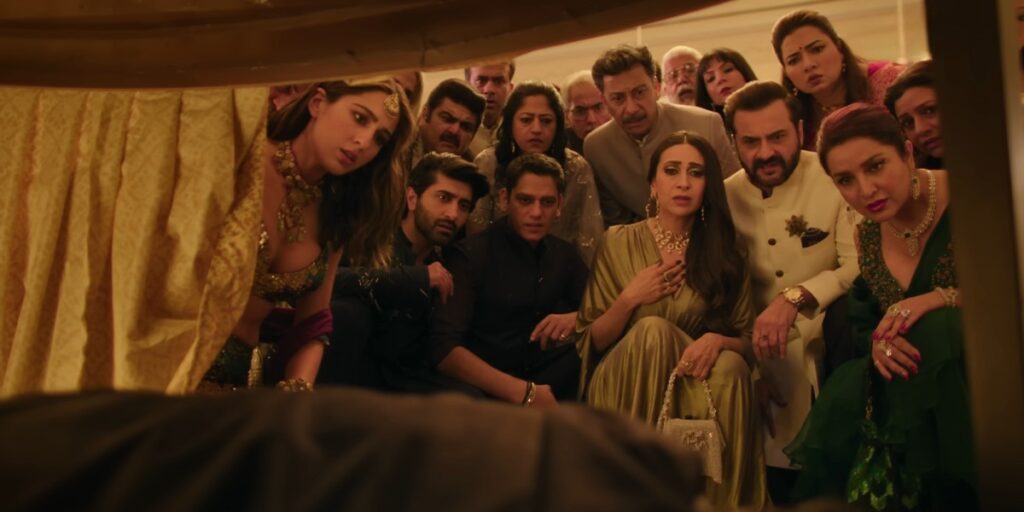
Sanjay Kapoor plays, the aristocrat “Rannvijay Singh,” who gives a tip of Rs. 20 to the waiters and takes the remaining food of the club’s party to his home. There is gossipy Roshni Batra (played by Tisca Chopra), and her spoiled brat drug addict son Yash (played by Suhail Nayyar), a sybarite Cookie Katoch (hilariously played by Dimple Kapadia).
There is the middle-aged superstar Shenaaz Noorani (Karisma Kapoor), who is also a single mother, and the communist lawyer Akshay Dogra (Vijay Verma), who is taunted by his mother for turning into a lefty after dating his Bengali girl.
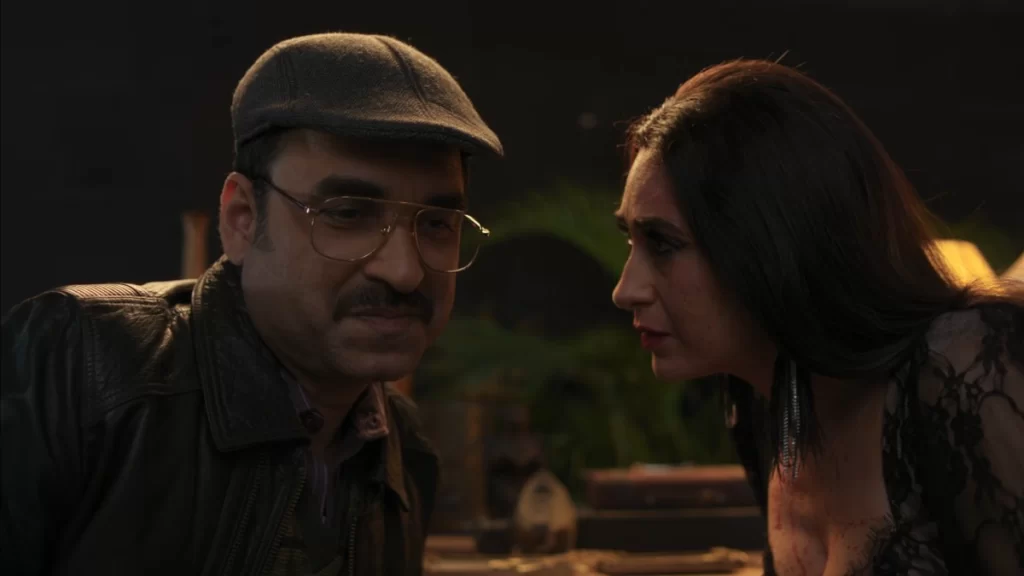
And of course, there is the overt Bambi Todi (Sara Ali Khan), who is labelled as a kleptomaniac widow and voluntarily engages in the murder investigation with ACP Bhavani Singh (portrayed by Pankaj Tripathi)
As the story progresses, these elite characters and their dark secrets get exposed. We are introduced to various social themes which manage to overlap the primary narrative of the plot from the outsider’s shoes (here, Singh is the common man like us).
We can see the racist and hypocritical environment in the club and its people, where the nannies are restricted from entering certain places of the club and two trainers (one from Karnataka and another from Arunachal Pradhesh) are informally called twins. And this hypocrisy is not only limited to the staff but also lives among the crazy rich clubbers. These characters are so engaging that there can be few anthology films whose plots revolve around these characters and the “Royal Delhi Club.”
I expected a lot from this film after watching its trailer. And why wouldn’t one, especially when a wonderful star is cast and the leading man is terrific Pankaj Tripathi, who never fails to entertain?
Also, the director himself, Homi Adajania has an interesting filmography which includes Finding Fanny (2014), Angrezi Medium (2020), Being Cyrus (2006) and my favourite, Cocktail (2012). Over these decades, Homi has introduced us to his cinematic world, where the characters he created stayed with us for over a decade.
What’s wrong goes in the film is the writing.
Especially in such cases where the film’s narrative should lead to the climax in such a way that the viewer cannot predict who killed whom. In Murder Mubarak, the writers had the privilege of holding the grip of the story through its characters where all are equally suspended for a valid reason. Still, the writers and the editor (Akshara Prabhakar) give us hints of the culprit through the quick cuts by taking us to the past of the characters where most of the questions arising in our detective minds are spoon-fed with answers.
For most of the time in the plot, the murder investigation is sided by the developing romance between the two characters.
If the viewer decides to not focus on the murder and just enjoy the moments happening in the film then he or she can cherish those moments. Certainly, I couldn’t.
You know when you watch a movie trailer, and not only does it give everything away but nothing about the film seems novel enough to grab your attention. That’s how I felt about Yodha.
But I was wrong. Well, not completely wrong.
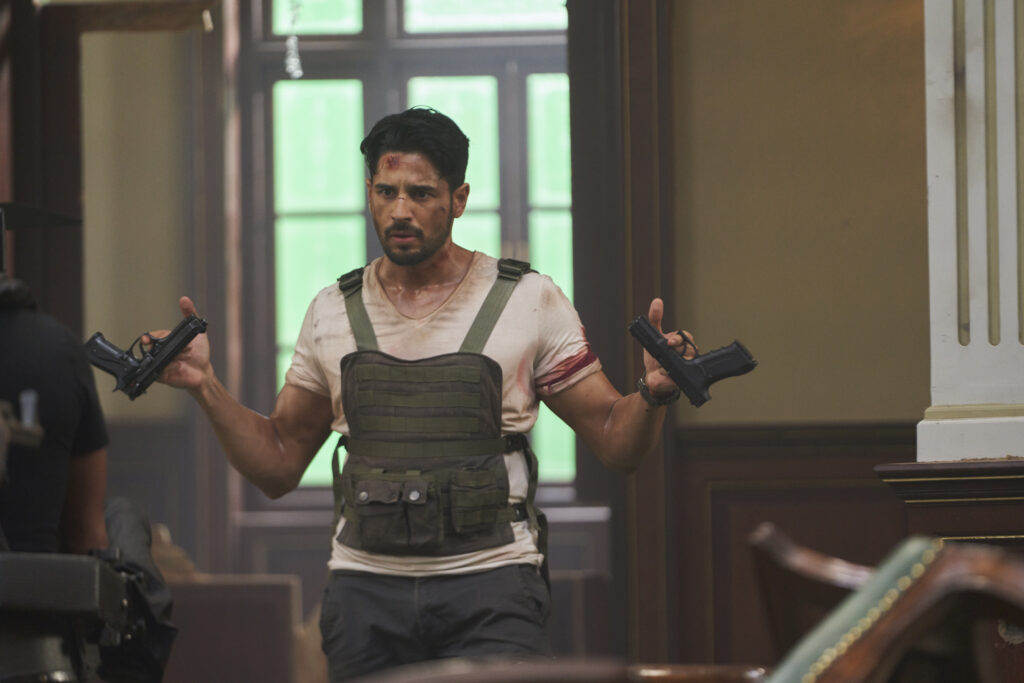
The film revolves around an elite unit called ‘Yodha Task Force’, which comes under scrutiny after a hijack incident led by Arun Katyal, played by Sidharth Malhotra. After years of proving his innocence and merit, losing his uniform, family, and friends, he mysteriously comes face to face with another hijacked aircraft that turns his life upside down.
And that leads me to some good and bad elements of the film, directed by Sagar Ambre and Pushkar Ojha, without revealing any spoilers.
Action and pacing:
The film opens on a high with an action-packed sequence which sets the tone of the film, as well as the suave ‘Yodha Task Force’. It prepares you for an out-and-out action drama. However, the pace keeps dropping from time-to-time when, with forced romantic songs and some unnecessary “cute moments”.
The action in the film is impeccable, especially in scenes when it’s confined within the limited space of an aircraft. But over the run time of 130 minutes, it gets a bit exhausting to see fight sequence after fight sequence…after fight sequence.
You can compare it to Tom Cruise’s never-ending destructive action in the Mission Impossible series. There’s only so much that’s bearable.
One sequence that’s exceptionally well crafted and executed is a 360-degree moving shot capturing a tussle between “hero and the villain” in a revolving aircraft.
If you’ve ever faced discomfort due to some turbulence mid-flight, this may be triggering.
The Conflict
For a film like Yodha that rests on the theme of patriotism, nationalism and protection of its citizens, the film does a commendable job at providing a balanced and liberal perspective.
It’s refreshing to watch a film that doesn’t rest on jingoism and othering a group of people, to resolve conflict.
It is a fight for freedom and peace, and a war against terrorism.
Performances
I’ve never been a huge Sidharth Malhotra fan, but he has definitely worked on his acting chops to shine as a “Yodha” in this film. From his physicality to his traumatic and melancholy state, and even his fierceness as a commando, Malhotra has shown great range to fit the part.
Raashii Khanna doesn’t have much to play with but comfortably portrays her role. Shout out to Kritika Bhardwaj for grabbing a primary part in the film. You’ll recognise her if you’ve seen the Netflix series Mismatched.
Another surprise performance in the film is by Disha Patani, playing an flight attendant named Laila. Look out for her.
Yodha take too long to establish the primary synopsis and conflict, adding too many details for the audience to remember in a short space of time. The stretched action sequences get redundant in portions, especially when you’re inching towards a resolve.
But it’s the right amount of twists and turns that continually draw you back in the narrative and keep you hooked, on ground and mid-air. A good one-time watch.
Shaitaan has rapidly emerged as this year’s most eagerly awaited supernatural thriller. With its ground-breaking distribution across more than 950 locations in over 60 countries on over 1200 screens, Shaitaan is setting the stage for unprecedented global anticipation with early paid previews and advances starting this week in key overseas territories such as USA and the GCC. This extensive outreach marks a milestone, positioning the film as Ajay Devgn’s biggest overseas release and widest overseas release for a film in its genre.
Directed by the acclaimed Vikas Bahl, Shaitaan features a powerhouse ensemble cast led by Ajay Devgn, alongside Jyotika and R Madhavan, offering a thrilling cinematic journey unlike any other. The film delves into the nightmarish ordeal of Kabir, portrayed by Ajay Devgn, and his family during what was supposed to be an idyllic weekend getaway, only to be disrupted by the arrival of a mysterious stranger.
R Madhavan delivers a compelling performance as the antagonist, bringing tension and intrigue to the home of Ajay and Jyotika’s characters, unveiling his dark intentions. This eagerly anticipated film has captivated global audiences with its powerful trailer, innovative marketing strategies, and interactive branding, heightening intrigue around the dark world of Shaitaan and black magic. Seamlessly weaving action, emotional depth, and the chilling aspects of Indian Black Magic, Shaitaan ensures an engrossing experience that will keep audiences riveted.
As the film’s release date nears, the promotional strategy has further intensified with out-of-the-box marketing initiatives, including the launch of POP OUT hoardings in India, showcasing an intense Ajay Devgn interacting with a voodoo doll, adding to the international buzz and anticipation for this edge-of-your-seat thriller.
Promising a ground-breaking film experience, setting new benchmarks for the genre on an international scale, Shaitaan is presented by Jio Studios, Devgn Films and Panorama Studios, produced by Ajay Devgn, Jyoti Deshpande, Kumar Mangat Pathak and Abhishek Pathak, and directed by Vikas Bahl.
Shaitaan releases internationally in cinemas on 8th March 2024 by Funasia Films and Marudhar Entertainment Network.
Do you behave better or worse when you’re being watched?
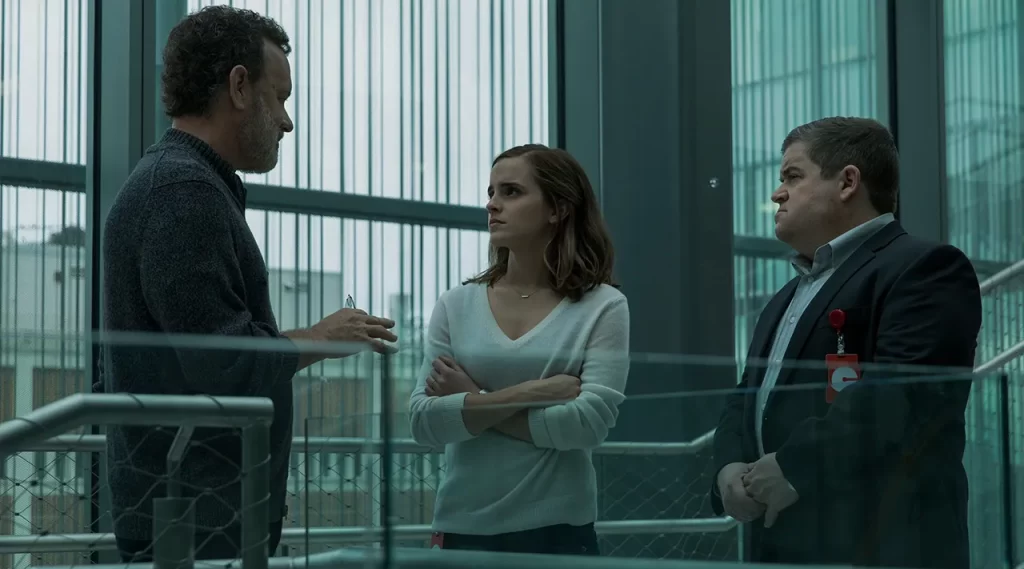
This is a question asked in the 2017 movie The Circle starring EmmaWatson and Tom Hanks, where a big tech firm promotes the idea of complete transparency and making knowledge accessible to the world… by documenting everything.
Mae Holland gets an entry level job at The Circle that has a swanky office with gyms, meditation centre, cool gadgets, social clubs, wellness programs and health plans for you and your family. The company’s core values are sustainability, integrity, respect, and the power of knowledge.
Their inventions are supposed to make the world a better / safer place with innovations such as a tiny, portable device that can serve as a surveillance camera which can be connected to multiple devices, so you don’t miss any detail.
Sounds noble and isn’t too far from reality.
But what if the same camera is plugged on you for the world to watch your every move, all the time. Mae finds herself in a position where her life is on display 24/7, for her family, friends, colleagues, and strangers to watch and scrutinize. And because it’s part of her job, her KRA, she must always be on her best behaviour.
This is when things take a drastic turn, seeming like an episode of Black Mirror.
The film eerily resembles our reality where we’re obsessed with documenting every part of our lives for the world to watch.
Whether it’s recording a Karen’s tantrum, an act of kindness, or simply a nice day with friends.
We all do it. I do it.
We blast our lives on social media for the world to weigh in, but still fight aggressively for our data protection rights. It’s no secret how the big tech companies function and feed our hunger for more content… and these days “everything is content”.
But the question the film raises is where do we draw the line between information, knowledge and entertainment ?